

Numerous studies show that emotional intelligence scores predict performance on critical life success factors. How strong is this effect?
Many studies have been conducted with small samples, and frequently the samples are primarily university students, so a new study examined over 75,000 individuals (primarily managers and employees from over 15 workplace sectors) from 126 countries.
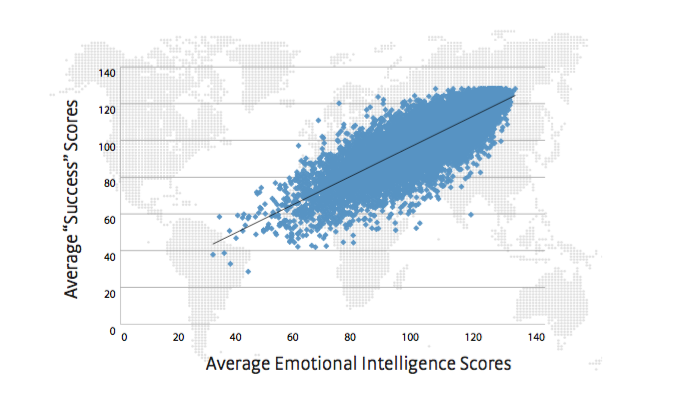
As shown in the graph below, there is an extremely strong, positive relationship between emotional intelligence test scores and success scores:
What to Notice?
- These variables move together, up to the right. It means that developing the learnable skills of emotional intelligence is, statistically, a sound way to improve scores on success.
- There’s an “empty space” in the top left and bottom-right. It means that if you want to have high success scores, you need EQ.
What Is Success?
On the vertical axis is an assessment of “Success” based on four factors, each with two sub-components:
-
- Effectiveness: capacity to generate results (includes Influence and Decision Making)
- Relationships: capacity to build and maintain networks (includes Network & Community)
- Wellbeing: capacity to maintain optimal energy and functioning (Balance and Health)
- Quality of Life: capacity to maintain balance & fulfillment (Achievement & Satisfaction)
To further understand the impact of emotional intelligence on performance, a regression model was created to show the EQ competencies with the highest effect on the Success scores. The largest single contributors to the model are “Exercise Optimism” (seeing possibilities) and “Engage Intrinsic Motivation” (internal drive).
These are both in the “Choose Yourself” part of the Six Seconds Model, which focuses on taking responsibility for personal action. This suggests that the core driver of success, in this study, comes from intentional action.
Expanding Success with Emotional Intelligence
The other key contributors are “Increase Empathy” and “Pursue Noble Goals” — which are in the “Give Yourself” part of the Six Seconds Model. As Harvard Business School’s Clayton Christiansen has written, true success requires looking outside ourselves. This finding suggests that the highest success in life requires connections with others, and the application of emotional intelligence skills toward a meaningful purpose.
For further details, including the analysis of which specific emotional intelligence competencies are tied to the success factors, download the State of the Heart report for free by filling in the form below.

Download State of the Heart: 2024 Report
Explore key findings and expert analysis:
What’s new in emotional intelligence?

Is Your Motivation Hiding? Shine a Light on It
What really fuels motivation? Recent neuroscience offers a suprising formula for fueling performance from the inside ou

Requesting Trust: 5 Practical Steps to Repair and Increase Trust
Want to increase trust with someone? Try this challenging-but-rewarding framework for requesting trust.

Assessing Trust
Want more clarity about how much you trust someone? Try these 3 techniques for assessing trust in a relationship.

Be Unapologetically You: The Emotional Intelligence Skills for Speaking Up
Why is it so hard to say what we really think? And feel? This post is a guide for using emotional intelligence to speak up for what matters.

Want a Good Life? 3 Lessons from Harvard Grant Study
Discover how the 85‑year Harvard Study of Adult Development shows that strong relationships—not wealth or IQ—predict a longer, happier life.

Negotiating Conflict with Emotional Intelligence
Want to “win” the argument? Negotiate conflict effectively by adding emotional intelligence in this simple 4-step process: Get REAL solutions!
