


No Rest for the Weary: Why Cultivating Rest Is an Art and a Science
by Patty Freedman
There are moments when rest feels like a miracle. I’ve felt it at so many points in life — after end of quarter deadlines, nights pacing with a newborn, crushing grief or painful nights post-surgery, through heartbreaks and menopause, and everyday stress, when my spinning brain is just not able to settle from the endless logistics of a too-full day. For me, rest has always arrived like a brief breeze through the stillness in a hot room: invisible, necessary, gone much too soon.
I’ve spent years studying rest — reading research, perfecting my sleep hygiene, investing in the right tools: blackout curtains, herbal supplements, silk pillowcases, smart rings, and tracking apps. I’ve optimized everything that can be measured. And yet, the more attention I’ve given to rest, the more I’ve tried to master it, the more elusive it has become.
It turns out, rest doesn’t respond to pressure. It doesn’t show up because you’ve earned it. It comes to you, like so many things in life, when you stop chasing it.
What Happens in Your Brain When You Rest
Rest isn’t just the absence of doing; it’s a biological and emotional shift. When we rest, our nervous system moves from its sympathetic state (fight, flight, or strive) into the parasympathetic state (rest, digest, and repair). In this mode, our heart rate slows, muscles release, and the vagus nerve signals safety throughout the body. It is a letting down of the burden we carry during the day, so we can begin the necessary work of making sense of ourselves.
Rest is where integration happens. Our default mode network — the part of the brain that comes online when we’re not focused on tasks — begins connecting ideas, weaving emotion with meaning. That’s why insight often arrives in the shower, or on a quiet walk, or during that delicious moment just before sleep.
Without rest, emotions and experiences pile up unprocessed. When we are chronically sleep deprived our physical and mental health suffers. Research showed that participants in sleep-deprivation condition exhibited a remarkable +60% greater magnitude of amygdala activation. When we are tired, our thinking is compromised, perception of threats higher and our coordination is slower. In fact driving sleepy may actually be more dangerous than driving drunk.
There are many kinds of sleep, and each serves a distinct biological purpose. Deep sleep, also called slow-wave sleep, is when the body releases growth hormone, repairs tissues, and strengthens the immune system. Research shows that during this stage, the brain clears metabolic waste that can coat neural pathways — a kind of nightly detox that protects long-term cognitive health. REM sleep (Rapid Eye Movement) is when most vivid dreaming occurs; it supports emotional regulation, learning, and memory consolidation by re-activating neural circuits formed during the day. Even lighter stages of non-REM sleep play a vital role: they help regulate metabolism, stabilize mood, and prepare the brain for deeper rest. Together, these cycles form the architecture of healthy sleep, a rhythm of rebuilding and restoration for both body and mind.
Why Sleep Is More Than Rest — It’s a Return
Sleep has always fascinated people, perhaps because every species studied, from jellyfish to elephants, experiences something like sleep. Even without complex brains, creatures follow this rhythm of withdrawal and return. That universality suggests that sleep isn’t a luxury of higher minds, but a fundamental rhythm of life itself, a pattern that sustains the living world.
Egyptians believed sleep was a temporary state similar to death, when the soul (ba) leaves the body. They saw sleep as a way to communicate with the dead and the divine, and their burial rituals reflected this connection. For many people sleep is an escape, a way to evade the thoughts or urgencies of their lives. As Hamlet exclaims “To die, to sleep— / To sleep! Perchance to dream: ay, there’s the rub.” But Shakespeare also describes sleep like this:
“Sleep that knits up the ravell’d sleave of care,
The death of each day’s life, sore labour’s bath,
Balm of hurt minds, great nature’s second course.”
— William Shakespeare, Macbeth
I’ve always loved that image — sleep as a repair, a re-threading of the day’s frayed edges. I think of sleep less as an escape and more as a return. It is a nightly surrender, where my body remembers how to be itself again.
Maybe that’s why sleep has always felt sacred to people, a liminal space between light and darkness, life and death. Each night we cross a small threshold, letting go of effort, control, and identity, trusting that something unseen will renew us. When morning comes, we begin again, and this feels revitalizing both physically and emotionally. As Heraclitus wrote “The sun is new each day.” And when I have a good night’s rest, that’s just how I feel.
Rest Isn’t a Break from Growth — It Completes It
Rest is not just important to our health, it is also an essential part of our work and learning. At Six Seconds, we describe growth as a cycle: Engage → Activate → Reflect.
Most of us are good at the first two. We engage with purpose, we activate our drive — and then– we forget to reflect. We treat the ending reflection as optional, even indulgent. But every system — biological, emotional, and organizational — depends on renewal before the next wave of effort begins. In nature, fields lie fallow between seasons so the soil can rebuild nutrients. Without that pause, the harvest weakens year after year. In our inner lives, emotions follow a similar arc. Each feeling has a beginning, middle, and end — a rise, release, and recovery. When we rush from one state to the next without space to integrate, the nervous system stays “on,” never completing its natural cycle. Over time, this unfinished energy accumulates as fatigue, irritability, or numbness.
Organizations work the same way. Teams need reflection as much as action. A study from Harvard Business School found that employees who spent just 15 minutes reflecting at the end of the day performed 23% better after ten days than those who didn’t. Reflection transformed effort into insight, turning experience into capability.

Neuroscience mirrors this: the brain’s default mode network activates during rest and downtime, linking new ideas and fostering creativity. In a Stanford study, people were 60% more creative after walking than when sitting still. Innovation doesn’t come from constant motion; it grows in the pauses where ideas have space to generate.
Ignoring these cycles doesn’t make us stronger or more productive, it only keeps us busy. The reflection isn’t a break from growth; it’s the foundation for the next layer of it.
The 7 Types of Rest — And Which One You Need Most
Once I stopped trying to perfect rest, I started noticing its many forms, each restoring a different part of life’s rhythm. Dr. Saundra Dalton-Smith explored this topic in her Tedxtalk and I’ve expanded her ideas here:
1. Physical Rest
This is the body’s recovery. Sleep, stretching, lying down, or even pausing for a long exhale all activate the parasympathetic system. Research shows that slow breathing and gentle movement lower cortisol and improve attention. Physical rest is how the body says, you’re safe enough to let go.
2. Emotional Rest
This is the relief of putting down the performance of being “fine.” It’s the moment you stop managing everyone else’s comfort and tell the truth about how you feel.
Neuroscience calls this affect labeling — naming emotions activates language areas in the brain, which reduces amygdala reactivity and increases choice. Emotional rest gives space for honesty, not avoidance.
3. Creative Rest
When the brain’s task networks finally go quiet, the default mode network lights up — the space of imagination, connection, and insight. This kind of rest doesn’t look idle; it looks like gazing out a window, humming, doodling, or wandering. Creative rest lets curiosity refill the well that effort drains.
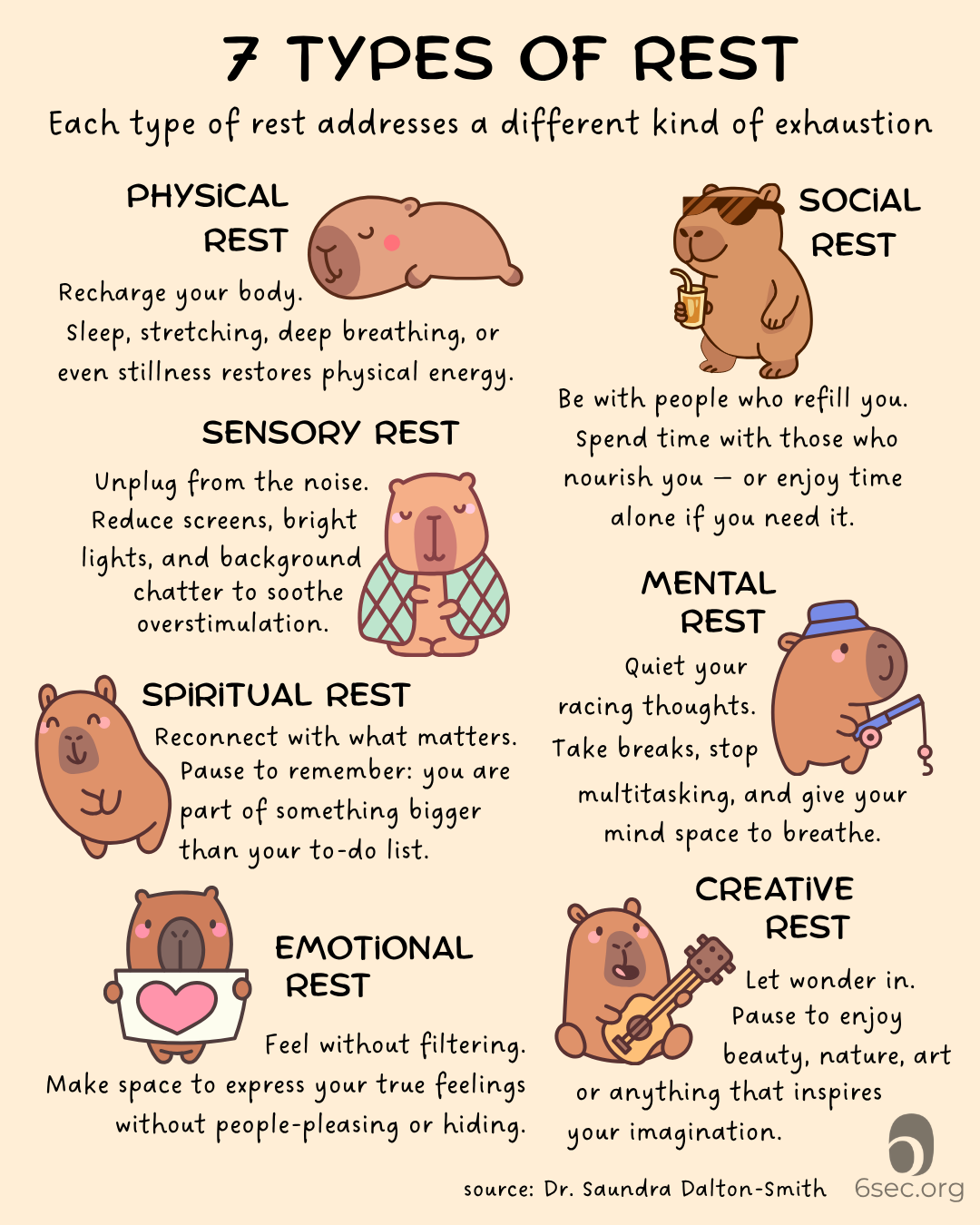
4.Sensory Rest
This is the quieting of overstimulation. Constant noise, light, and digital input keep our senses on high alert, even when we don’t notice. Sensory rest invites stillness — dimming the lights, closing your eyes, or stepping outside into natural sound and color. It’s how the nervous system remembers that not every signal needs a response.
5. Mental Rest
This is the rest of release — the pause from constant thinking, planning, and problem-solving. But constant thinking exhausts the brain’s focus circuits. Mental rest comes through pausing or taking “brain breaks”: a walk, deep breathing, or simply letting your thoughts drift. In these moments, clarity and creativity quietly return.
6. Social Rest
This is the rest of authenticity. It’s what happens when you spend time with people who recharge you — or when you allow yourself solitude without guilt. Social rest restores emotional balance by reducing the effort of performance. It reminds us that connection works best when it’s real.
7. Spiritual Rest
This is the rest of belonging — remembering that we’re part of something larger than our to-do list. Studies show that connecting with purpose and awe activates the brain’s reward and bonding systems, increasing dopamine and oxytocin. When we pause to ask, What really matters right now? we realign energy with meaning.
How do you know which type of rest to prioritize? The kind of rest you need most is the one you’ve been denying. Listen to your fatigue — it’s data. When you’ve been over-engaging, your body calls for physical or sensory rest. When you’ve been over-activating, emotional and social rest help you reconnect. When you’ve been skipping reflection, creative or spiritual rest restores meaning. Paying attention to where you’ve been living in the cycle reveals what’s missing. Your body, emotions, and energy always know where restoration must begin.
You Can’t Force Rest — But You Can Invite It
You can’t schedule a breeze, but you can open the window to let more rest into your daily life.
This week, choose one kind of rest that feels most out of reach for you: physical, emotional, creative, sensory, mental, social, or spiritual.
Notice how that kind of depletion shows up — and try one small act to refill it.
A few ideas to experiment with:
- Pause for a yawn. Research suggests that slow, intentional yawning can reset the nervous system, increase alertness, and calm overactive circuits — a micro-moment of rest for body and brain. Even fake yawns yield benefits to help you get regulated!
- Try a “minute of nothing.” Set a timer for sixty seconds and do absolutely nothing. Let your mind wander, your shoulders drop, and your breath find its own pace. Opening up time for boredom is a practice so start small!
Change up your senses. Step away from your dominant sense for a moment and tune it to your others. Close your eyes for sound, turn off notifications for silence, or walk barefoot for touch. There is a lot of research on mindfulness and grounding practices that support wellbeing through our senses. Try one!
Rest Is the Exhale That Brings You Back to Yourself
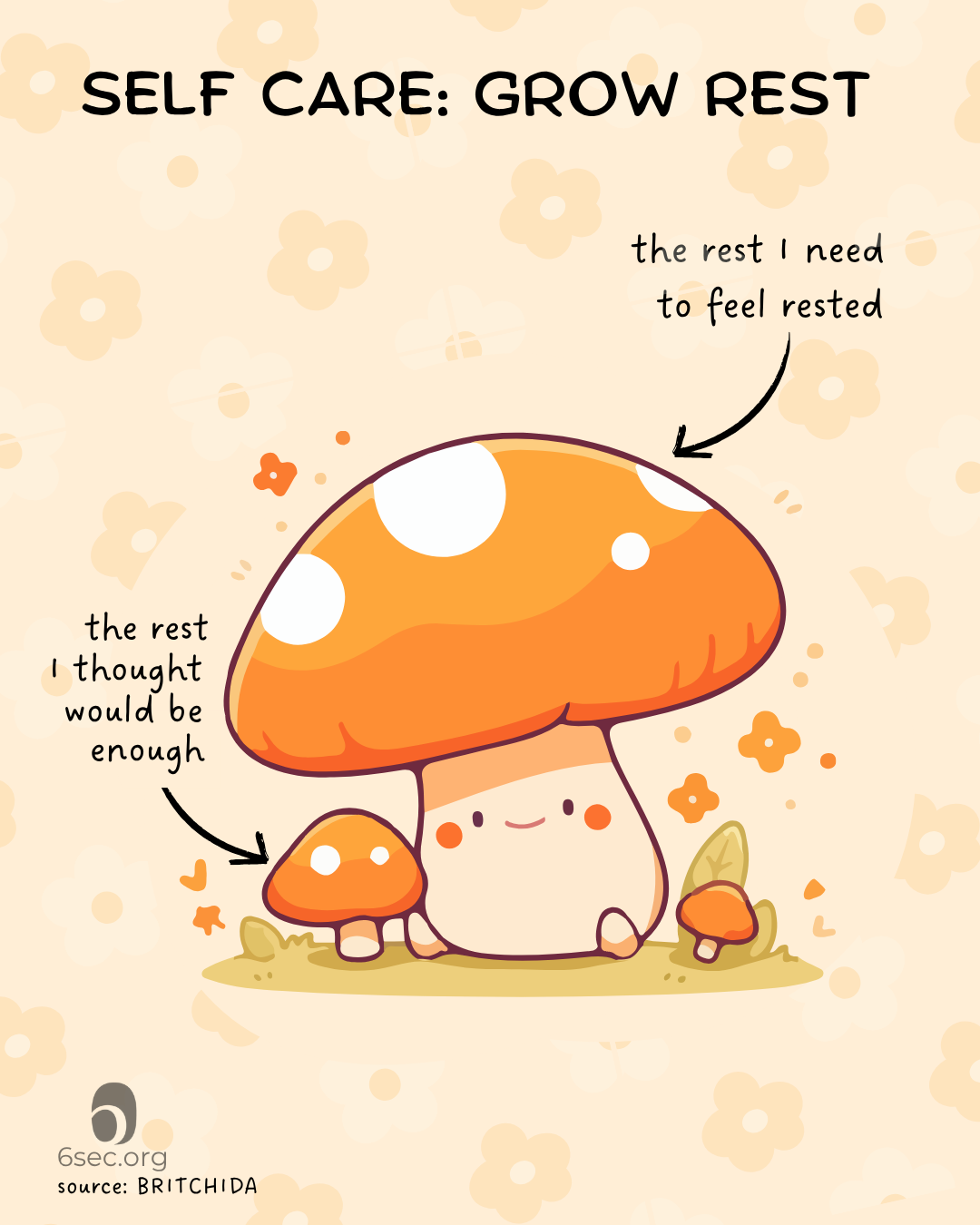
Maybe rest really is like that breeze — fleeting, sometimes random, but full of comfort. I hope you come to appreciate it as I have, like a cool drink at the end of a long hike. It’s the exhale that lets the inhale return, the winter that makes spring possible. When we really practice that cycle — Engage, Activate, Reflect — we remember that rest isn’t something we earn for a good day’s work. It’s something we make space for, and paradoxically, rest will come to us only when we stop trying to catch it.
For more articles, I recommend:

- Is Your Motivation Hiding? Shine a Light on It - February 3, 2026
- Six Seconds 2025 Impact Report: Global reach, measurable outcomes anda growing movement for emotional intelligence - January 2, 2026
- The Holidays Can Be Something We Make, Not Something We Survive - December 7, 2025