

Leading Change in Times of Uncertainty: Why Managing Transitions Matters More Than Strategy
In volatile environments, people don’t resist change, they resist unresolved emotional transitions. Leaders who ignore this pay for it in stalled execution, quiet disengagement, and repeated failure.

Why Change Feels Riskier Than Ever
Senior leaders are navigating a convergence of pressures: economic volatility, geopolitical instability, technological acceleration, and ongoing workforce fatigue. In this environment, even well-designed change initiatives are stalling.
One reason is often overlooked. As uncertainty increases, change feels riskier, even when the objective risk has not changed. And change, by definition, asks people to step into the unknown.
Recent research on global emotional intelligence trends shows that people across regions and sectors are operating in a heightened state of emotional challenge. Levels of optimism, adaptability, and resilience have declined, making it harder for individuals and organizations to absorb disruption and move forward with confidence (Freedman et al., 2025).
Most change efforts fail, not because the ideas are wrong, but because the emotions that should guide and fuel the process aren’t used skillfully.
This matters because when people feel emotionally taxed, their capacity to take risks narrows. Innovation slows. Initiative drops. Even reasonable change begins to feel unsafe.
Why Strategy Alone Stops Working Under Intense Uncertainty
When uncertainty spikes, many leaders respond by doubling down on planning. More scenarios. More dashboards. Bigger decks. Often built by expensive consultants, promising clarity in chaos.
In times of uncertainty, change becomes a risk problem before it becomes a strategy problem.
The problem is not the quality of the plans. In conditions of high uncertainty, plans inevitably fall apart. Assumptions shift. Timelines slip. Priorities collide.
What organizations actually need in these moments is not a perfect roadmap, but resilience and agility, fueled by people who are connected to purpose and supported by trust.
As I write in the new book on emotional wisdom, Emotion Rules:
“Most change efforts fail, not because the ideas are wrong, but because the emotions that should guide and fuel the process aren’t used skillfully. The real challenge of change isn’t external; it’s emotional.”
When leaders push harder on execution without addressing emotional readiness, they unintentionally increase threat. People comply on the surface while disengaging underneath. Momentum looks good on paper, but erodes in practice.
Change vs. Transition: The Leadership Blind Spot
This is where many capable leaders misdiagnose the problem.
Change is external. It is the new strategy, system, structure, or operating model.
Transition is internal. It is the emotional process people go through as they let go of what was familiar and step into something unproven.
Under uncertainty, transitions are harder. The unfamiliar triggers caution. Even positive change can destabilize identity, confidence, and belonging. Resistance is rarely opposition to the future. More often, it is attachment to meaning in the present.
When leaders treat resistance as something to overcome rather than something to understand, they miss critical information about what people are protecting, and what they need in order to move.
Emotional Relevance Is the Gateway to Movement
The question leaders must answer is not, “Do people understand the change?” but, “Does the future feel compelling enough to step toward?”
From Emotion Rules:
“From a neuroscience standpoint, we only truly engage with change when it’s emotionally relevant. That means the future has to feel more compelling than the pull of the present.”
As Max Ghini and I wrote in Inside Change, it is not enough for people to know the vision. They need to feel the vision. From a neuroscience perspective, that felt sense of the future creates valence, the emotional energy required for the brain to shift out of the comfortable and familiar.
This is especially critical now. When optimism and adaptability are under strain, leaders cannot assume motivation will follow logic. Emotional relevance must be built intentionally through meaning, connection, and shared purpose.
From a neuroscience standpoint, we only truly engage with change when it’s emotionally relevant.
Download your free guide to Handle Emotions with Wisdom
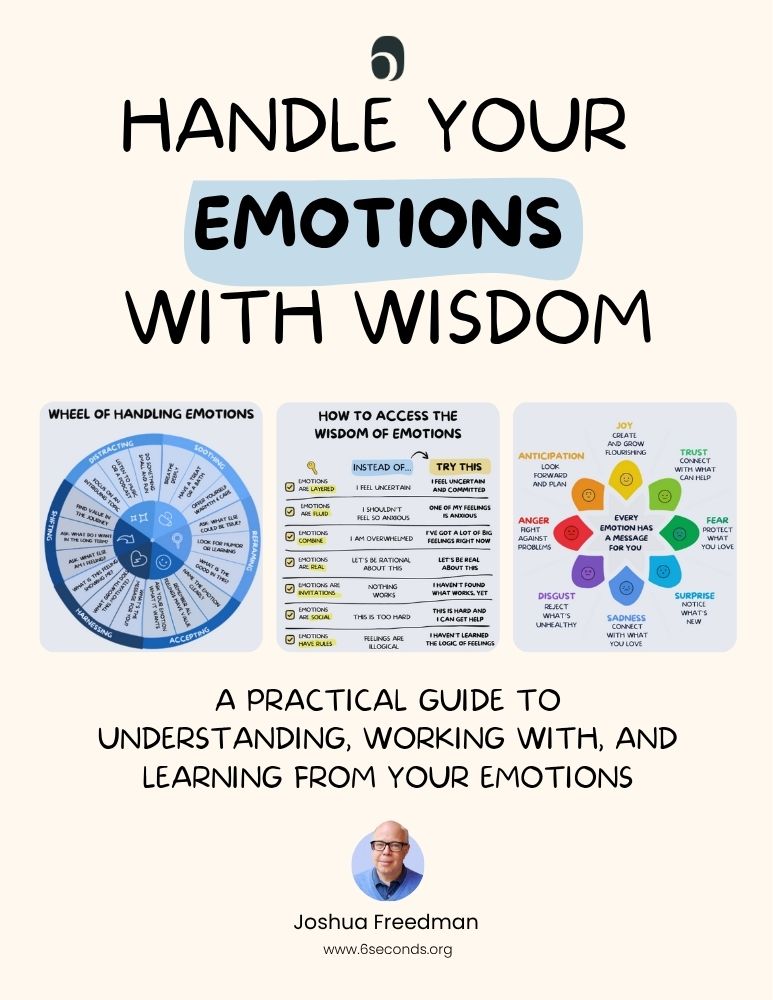
Get your free guide to handling diffcult emotiions by filling in this form; it includes 18 strategies, 7 tips for accessing the wisdom of emotions, and one of my favorite frameworks for understanding the meaning of emotions.
Leading Transitions with the Change Map
This is where managing change gives way to leading transitions.
The Change Map offers a practical way to align emotional readiness with execution by recognizing that change unfolds in cycles, not straight lines. It focuses on three stages:
-
Engage: Build trust, surface what matters, and create emotional readiness.
-
Activate: Support safe experimentation and learning, not perfection.
-
Reflect: Consolidate insight, identity shift, and learning before moving on.
Most change failures occur when leaders skip Engage or rush past Reflect. Without engagement, people comply without commitment. Without reflection, organizations repeat the same change under a different name.
Leaders who slow down at the right moments create the conditions for sustainable momentum. Read more about the Change Map here.

When uncertainty rises, resilience and agility matter more than perfect plans.
The Leader’s Real Job in Times of Uncertainty
In uncertain times, change cannot be driven by pressure alone. It must be carried by people who feel safe enough to experiment, committed enough to persist, and connected enough to trust one another.
That work starts with leadership.
Leaders set the emotional tone, not just through what they say, but through what they model. Their willingness to engage uncertainty, to acknowledge emotional realities, and to invest in trust determines whether change becomes something people survive or something they help create.
As Emotion Rules reminds us:
Change only sticks when it moves through the emotional brain, through the stories we tell ourselves, and through the connections we make.
In times of uncertainty, the leaders who succeed are not the ones who push change harder. They are the ones who help people feel their way forward.
Change only sticks when it moves through the emotional brain… and the connections we make.
For more on how to use emotional intelligence to handle challenges, I recommend:
Learn the essential of emotions

- Leading Change in Times of Uncertainty: Why Managing Transitions Matters More Than Strategy - December 28, 2025
- Emotion AI: A Leader’s Guide to Use Emotional Intelligence for Effective AI Adoption and Change Management - December 2, 2025
- Requesting Trust: 5 Practical Steps to Repair and Increase Trust - November 20, 2025